Framing Blackness, Missing Resonance: Spike Lee's Highest 2 Lowest
When big themes meet uneven execution: what Spike Lee’s latest reveals about art, culture, and identity.

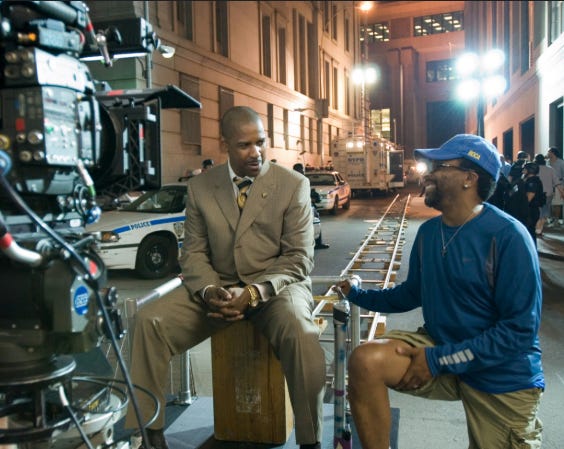
Author’s Note
I need to start with this: I freaking love Spike Lee as a director. I love his films with Denzel Washington, and I’ll always respect the legacy they’ve built together. That’s why writing this piece wasn’t easy. But honesty matters more than comfort. Highest 2 Lowest isn’t just another film. It’s a cultural text that asks us to wrestle with fathers and sons, incarceration, artistry, and identity. The fact that it doesn’t quite deliver makes the conversation around it even more important. This isn’t about tearing down a hero; it’s about unpacking what happens when the story falls short, and what that reveals about the bigger picture of Black culture, masculinity, and media today.
✨ Note to Readers: This essay is the long-form version of my review of Highest to Lowest. If you want the full video breakdown, check it out on Instagram: @scripted_insights_ and join the conversation there.
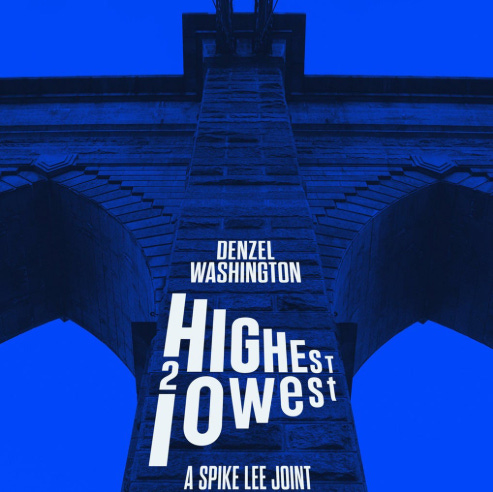
The Weight of Expectations
Spike Lee and Denzel Washington’s collaborations are landmarks in Black cinema, mega touchstones that shaped the way I see and love film and the way I see myself in it. Mo’ Better Blues. Malcolm X. He Got Game. Absolute all-time classics in film history. When Spike and Denzel work together, the results are usually nothing short of electric.
But Highest 2 Lowest? I have to be honest. This one is by far the weakest of their collaborative efforts. And saying that hurts, because it means holding accountable a director and actor who’ve given us so much.
“If we can’t critique our icons when the work falls short, then we’re letting the most important conversations slip away.”
The Promise of the Premise
On paper, Highest 2 Lowest should have been an absolute powerhouse. It’s a remake of Kurosawa’s 1963 classic High and Low: a film that split itself in two, half chamber drama and half street-level procedural, to explore class division in postwar Japan.
Kurosawa turned a crime story into a meditation on power, morality, and the social cost of ambition.
Spike had the chance to do something similar for America right now. Instead of the streets of Yokohama, he gave us New York. Instead of class warfare in Japan, he set up a battle between legacy and street credibility, between authentic artistry and commercialized culture. Fathers and sons, incarceration, intergenerational conflict, and the soul of Black musicianship itself. The themes were right there. The emotional weight, unfortunately, was not.
And the execution? Uneven tone, misplaced flourishes, and moments that should have landed with gravity were drowned out by laughter.
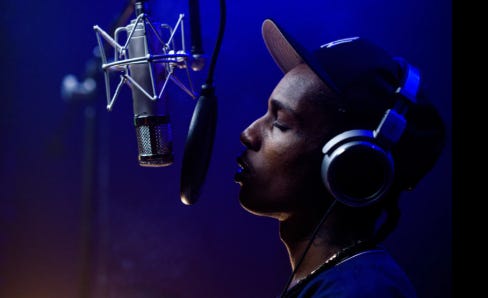
When Tone Betrays the Truth
The best example is the film’s central confrontation between King (Denzel Washington), the elder statesman of music, and Young Felon, the up-and-coming rapper. This is the scene the whole film builds toward: two generations colliding, two visions of masculinity and artistry squaring off.
The dialogue hits powerful notes, King asking, “Are you gonna be like your father? Are you gonna do a bid like him? Who taught you to hate yourself?”
Those words could have cracked the theater open.
But when I saw it, twice, people laughed. Real laughter. And I know Spike didn’t intend that. He even told Time Magazine this was supposed to be a pivotal moment. But the rhythm of the scene, the rhyme schemes, and the stylized delivery—instead of deepening the tension, undercut it.
As someone whose father spent most of his life in prison, that hit me hard. Those words carry personal weight. But the way Spike staged it robbed it of resonance. Silence would have spoken louder.
“When the tone is off, even the truest words lose their power.”
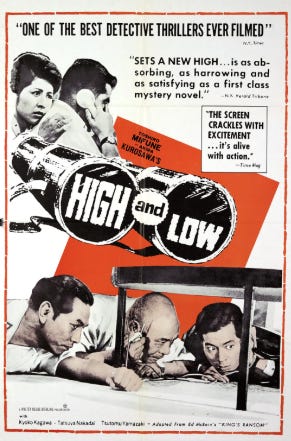
The Ghost of Kurosawa
Part of the disappointment with Highest to Lowest comes from the long shadow of Akira Kurosawa’s High and Low (1963). That film didn’t just work; it absolutely soared! Kurosawa managed to weave a crime thriller, a social critique, and a meditation on ambition into one package that still feels sharp sixty years later.
In High and Low, Toshiro Mifune plays Kingo Gondo, a high-powered executive on the cusp of the biggest night of his career. As he prepares to enter the corporate world, a phone call informs him of his son's kidnapping. From there, the film splits in two: the first half unfolds in Gondo’s sleek, air-conditioned mansion—a chamber drama where tension builds like a vice—and the second half plunges us into the streets of Yokohama, following detectives as they comb through the polluted, overcrowded underbelly of the city.


That duality is what makes the film feel almost biblical in scope. It gave me Dante’s Inferno vibes the first time I saw it: a man begins in his ivory tower, literally looking down on the city below, and is forced to descend into the chaos of pollution, violence, and desperation before reemerging, completely transformed by what he’s seen.
Kurosawa was already working from American source material: Ed McBain’s pulpy paperback King’s Ransom. But he saw something more in it. He discarded most of the novel’s procedural plotting and instead built a story that mirrored the sociopolitical tensions of Japan in the 1960s. Postwar Americanization was reshaping the country. Factories were booming; Western goods such as TVs, cars, and air conditioners were flooding in, but the cost of that progress was a widening gulf between the rich and the poor. At the same time, protests against U.S. military expansion rocked the streets, one even ending with a student killed, the Japanese prime minister resigning, and then-President Eisenhower canceling a visit.
That’s the backdrop of High and Low. Gondo’s home at the top of the hill represents desire, privilege, and aspiration. The Yokohama streets below, filmed in noirish shadows, represent the violence and anxiety of those left behind. Kurosawa makes us feel that split-vision Japan was living: America as both dream and domination.
Now fast forward to Spike. He clearly tried to mirror that structure. Denzel’s character starts out in his glassy Dumbo penthouse, a man of wealth and influence, and then is eventually dragged down into New York’s visceral, energized streets. On paper, it’s the same descent Kurosawa used so brilliantly. But on screen, it never felt authentic.
Even the vividly filmed Puerto Rican Day Parade sequence, which could’ve been a moment of cultural rootedness, a celebration of the city’s lifeblood, played like fancy set dressing. Instead of grounding the story in New York, it reminded me I was watching a constructed film. The film failed to provide a genuine sense of immersion.
The lack of rootedness was incredibly glaring for the two born-and-raised New Yorkers involved in this film, both in front of and behind the camera. And it’s where the ghost of Kurosawa haunted me the most. The contrast between the boardroom and the streets in Kurosawa's Japan evoked a sense of urgency and authenticity. Spike’s New York? It often felt like a backdrop, an echo of a structure without the substance that made Kurosawa’s version endure.


Casting, Music, and the Missed Notes
The film also suffered from what felt like stunt casting. Elijah Wright (Jeffrey Wright’s son), A$AP Rocky, Ice Spice, cameos that pulled attention without adding depth. Even Denzel felt miscast.
His character was supposed to be a 50-Cent-style archetype: a man who rose from the streets, turned violence into music, and then into executive power. But we never got the backstory of his rise through the ranks, from squalor to success. We never understood why he fought so fiercely for artistic legacy over commercial hits. Without that grounding, the moral conflict between art and commerce didn’t land.
And the music? That was maybe the biggest letdown. If you’re making a film about New York music and Black cultural identity, how do you not have Biggie? Nas? Mary J. Blige?
Instead, we got background scoring that sounded like elevator music during what should have been the most dramatic and claustrophobic moments, closer to a Hallmark drama than a Spike Lee joint.
“For the director who gave us Mo’ Better Blues, this felt almost unforgivable.”
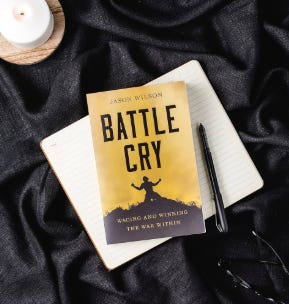
Battle Cry and Comprehensive Manhood
Jason Wilson’s Battle Cry talks about the fight for “comprehensive manhood,” moving beyond shallow definitions of masculinity based on bravado, toughness, and street credibility, and embracing courage, discipline, empathy, and presence.
That’s the battle that should have been at the heart of Highest 2 Lowest.
King versus Young Felon wasn’t just old versus young or jazz versus rap. It was supposed to be about whether Black men can step beyond the traps of incarceration, fatherlessness, and hollow validation to embrace something fuller, deeper, and freer.
That’s the question Wilson raises in his book, and that’s the question Spike’s film only hinted at before losing it in tonal missteps.
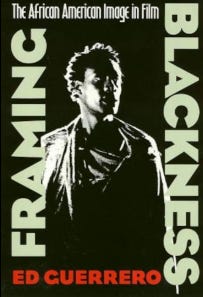
Framing Blackness and Cultural Representation
Ed Guerrero’s Framing Blackness reminds us that Black film is never just entertainment. Every representation is loaded, political, and shaped by the weight of history. Hollywood has long packaged Black identity through stereotypes: criminality, hyper-masculinity, and suffering. Because that’s usually what sells in mainstream media.
Spike Lee knows this better than anyone. His best films interrogate those very stereotypes. But Highest 2 Lowest risks falling into them. By skimming the surface of incarceration, absent fathers, and cultural identity, the film gestures at big ideas without grounding them in lived authenticity.
It rehearses pain without transcending it.
That risk is nowhere clearer than in the dreamlike “Trunks” sequence. Shot with Spike’s signature double dolly, Young Felon floats toward the camera as he performs his number-one hit. The effect should feel like transcendence, a step outside ordinary time. Instead, it plays like a rap video ripped from the culture industry: women’s bodies deployed as props, twerking in perfect unison; Felon rapping directly into the lens, dripping bravado; misogyny framed as spectacle.
Here Guerrero’s warnings ring loud. What we see isn’t just fantasy; it’s a recycling of the same formulaic stereotypes that have long defined Blackness on screen. Black masculinity distilled into aggression and posturing. Black women flattened into symbols of desire and excess. Authenticity reduced to spectacle.
Spike’s double dolly has historically signaled transformation—a character crossing into some liminal, heightened state. But here it underscores Guerrero’s point: media, even in the hands of a master filmmaker, can reproduce the very images it should be critiquing. Instead of interrogating the trap of representation, the sequence risks reinscribing it.
The problem is compounded by Lee’s indulgence in unrelated flourishes that add nothing to the story. Take, for example, the scene in which Washington’s character is ordered to deliver ransom money to a strategic location in the Bronx, near Yankee Stadium. On the subway ride there, Spike can’t resist inserting himself as a Knicks and Yankees superfan. Suddenly, the train floods with Yankee fans who break the fourth wall and chant “Boston Sucks!” directly into the camera. It’s loud, it’s long, and it’s repeated again when Washington exits the train a few scenes later. The whole detour feels needless, even thankless—gratuitous fan service that disrupts the film’s tone at a critical narrative moment.
When you hold these choices up against Kurosawa, the difference is stark. In High and Low, every visual shift is purposeful. The descent from Gondo’s sterile mansion into the streets of Yokohama isn’t just a change in scenery; it’s a symbolic plunge into the social and moral underbelly of postwar Japan. Kurosawa’s stylistic flourishes deepen the themes, drawing us closer to the tension between ambition and humanity, wealth and poverty.
Spike’s flourishes here—the rap video fantasy, the gratuitous Yankee chants—do the opposite. They pull us out of the story, break the immersion, and, in Guerrero’s terms, risk flattening Black representation into cliché. Where Kurosawa used style to sharpen his critique of class warfare, Lee too often uses style as ornament, or worse, distraction.
“Representation without resonance risks becoming caricature.”
Why This Conversation Matters
So why spend time on a film that didn’t deliver? Because film shapes culture. And culture shapes how we see ourselves.
When a film such as Highest 2 Lowest falls short, it's not solely due to the shortcomings of Spike Lee or Denzel Washington. It’s about what stories are being told about us and how they’re landing with audiences.
This film is still worth watching, not because it’s flawless, but because it sparks conversation. It forces us to ask: What does it mean for Black masculinity to be reduced to street credibility? What happens when the silence of fathers is filled with bravado? And how can art, real art, break those cycles instead of recycling them?
Jason Wilson challenges us to fight for comprehensive manhood. Ed Guerrero challenges us to see through the framing of Blackness that Hollywood serves us. And Highest 2 Lowest—for all its flaws—sits right in the tension between those two.
Closing Reflections
I’ll always love Spike Lee. I’ll always honor what he’s given us. But love doesn’t mean silence. Critique is a form of care, too.
When the tone is off, when the music misses, and when the weight doesn’t land, we owe it to ourselves to call it out, to ask for better, and to keep the conversation going.
Because representation isn’t just about being seen. It’s about being seen clearly.
Reader’s Note
Thank you for reading this installment of Scripted Insights. If you haven’t seen Highest 2 Lowest yet, I encourage you to watch it and sit with your own reactions, even if they’re different from mine. What stood out to you? Where did the film resonate, and where did it miss?
I’d love to hear your perspective. Share your thoughts in the comments, or reply directly if you’re reading this by email. Conversations like these matter because they sharpen not just how we see cinema, but how we see ourselves reflected through it.
And if you want to dig deeper, I highly recommend Ed Guerrero’s Framing Blackness and Jason Wilson’s Battle Cry. They’ll give you powerful lenses for thinking about how media frames Black identity and how Black men, in particular, are invited to move beyond surface definitions of strength toward something more whole.
Let’s keep this dialogue alive.
📚 References
APA (7th Edition)
Guerrero, E. (1993). Framing Blackness: The African American image in film. Philadelphia: Temple University Press.
Wilson, J. (2021). Battle cry: Waging and winning the war within. Nashville: Thomas Nelson.
MLA (9th Edition)
Guerrero, Ed. Framing Blackness: The African American Image in Film. Temple University Press, 1993.
Wilson, Jason. Battle Cry: Waging and Winning the War Within. Thomas Nelson, 2021.